Three basic rules

Three basic rules

For a longer battery life.

  1. Do you mainly drive short distances? Audi recommends charging up to 80% for daily use.
  2. Would you like to drive long distances? To reach the maximum range, like to charge your Audi to 100% and drive off as directly as possible. However, if you regularly charge your Audi to 100% in deviation from rule 1, the aging process of the battery will be accelerated and the usable battery capacity will decrease comparatively faster.
  3. Do you have longer service lives? When parking the vehicle, pay attention to a charge level between 30% and 80%.

Your vehicle supports you with battery care

Table
 
Short distance
(e.B. daily commute to work, shopping)
Long-haul
(e.B. holiday trips, business trips, commuter)
Charging destination setting
In the myAudi app and in your vehicle, you can easily define a limit for the maximum battery charge. So you don't have to worry about anything else.
Configuration to 80%
Before long-distance journeys, Audi recommends setting the charging destination to 100% in order to achieve the longest possible range.
Charging timer
With the charging timer you set the exact time of departure. Directly in the vehicle or conveniently via myAudi app. This means that the automated charging process with a pre-set battery level is as close as possible to the departure time. In addition, the preconditioning air-conditioning of the vehicle interior before departure to the desired temperature.
Preconditioning for greater comfort
Set departure time to avoid downtime with a full battery
Route planning
Plan your route with the e-tron route planner before you start your journey: The route takes into account your individual range and provides appropriate charging stations for you.
Application of the e-tron route planner if required
Application of the e-tron route planner recommended
Driving mode
The "efficiency" driving mode leads to lower energy consumption through an efficient driving style. This reduces the electrical and thermal battery load. This preserves the battery capacity.
Charging tips

Charging tips

  • Fast charging (High Power Charging > 100 kW) is mainly recommended for long distance, not for daily use.
  • With High Power Charging, the charging speed slows down as the state of charge of the high-voltage battery increases. Therefore, a full charge of the high-voltage battery can extend the total journey time. The e-tron Route Planner supports you with optimal charge planning.

Battery maintenance

  • To keep charging times low on a long-distance trip, the e-tron Route Planner falls back on the full battery capacity if necessary and recommends a charge above 80 %. After a long-distance journey, set your charging target back to 80 % for your daily journeys.
  • When using the e-tron Route Planner with the Audi e-tron GT*, the temperature of the high-voltage battery is preconditioned for fast charging in order to achieve the maximum charging speed.

* Consumption and emission figures: Electricity consumption combined: 19.6-18.8 kWh/100 km (NEDC); 21.6-19.9 kWh/100 km (WLTP); CO2 emissions combined: 0 g/km.

Battery maintenance

Warranty and service life of your battery

All high-voltage batteries for Audi plug-in hybrids and all-electric models are designed for a long service life and Audi guarantees them for eight years after initial delivery or for the first 160,000 kilometres - whichever comes first.

Battery protection

Battery protection

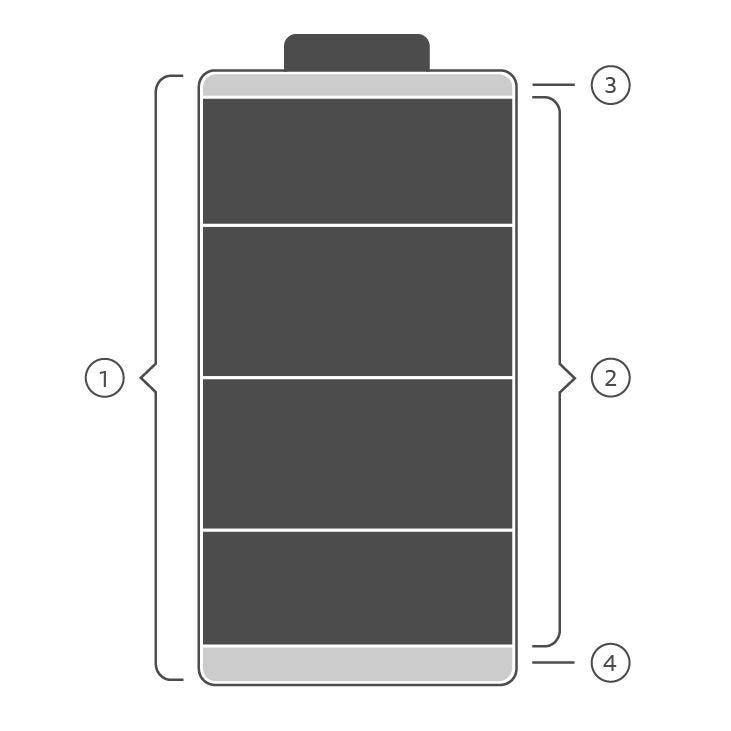
included buffers provide additional protection for your high-voltage battery against unintentional, damaging overcharging and deep discharging.

  1. total capacity (gross)
  2. usable capacity (net)
  3. protection against overcharging
  4. protection against deep discharge

The graphic is for symbolic illustration purposes only.

Battery capacity

Battery

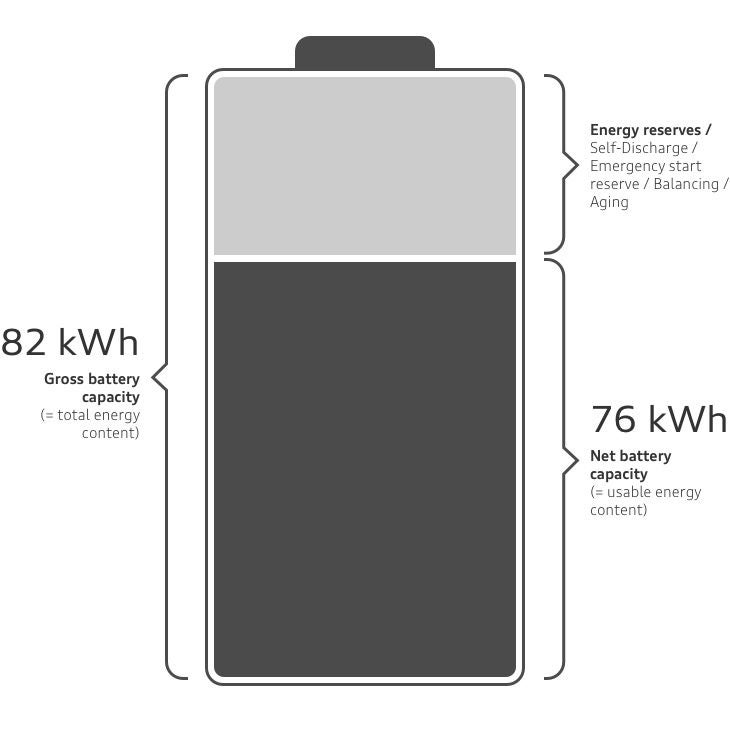
The capacity of the high-voltage battery of an electrically powered vehicle is divided into gross and net capacity. The gross capacity describes the entire physical capacity of the high-voltage battery. However, to protect against self-discharge, to increase the service life and to ensure the emergency start reserve, the theoretically available energy content is technically limited. This actually usable energy content is called net capacity.

The graphic is for symbolic illustration only. The battery capacity is shown using the example of the Q4 e-tron 40*. <br>*Consumption and emission values: Combined power consumption in kWh/100 km: 17.7 – 16.3 (NEDC); 20.1 - 17.3 (WLTP); combined CO₂ emissions in g/km: 0


Loading..